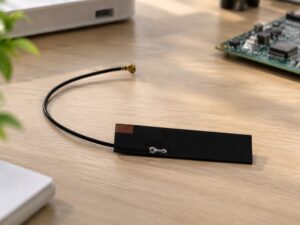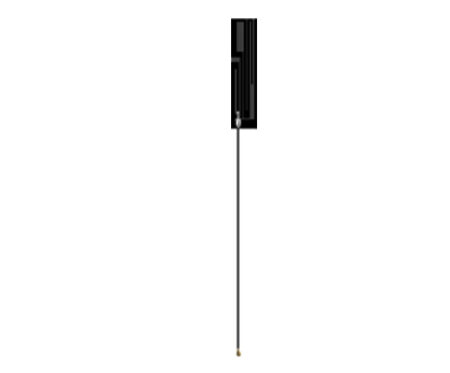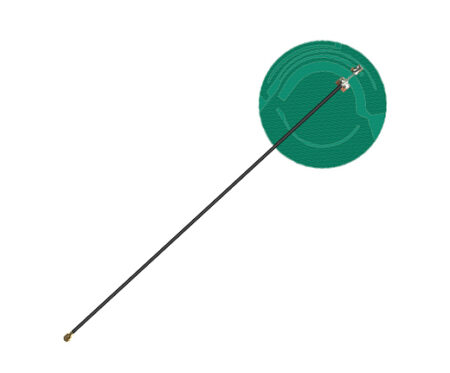
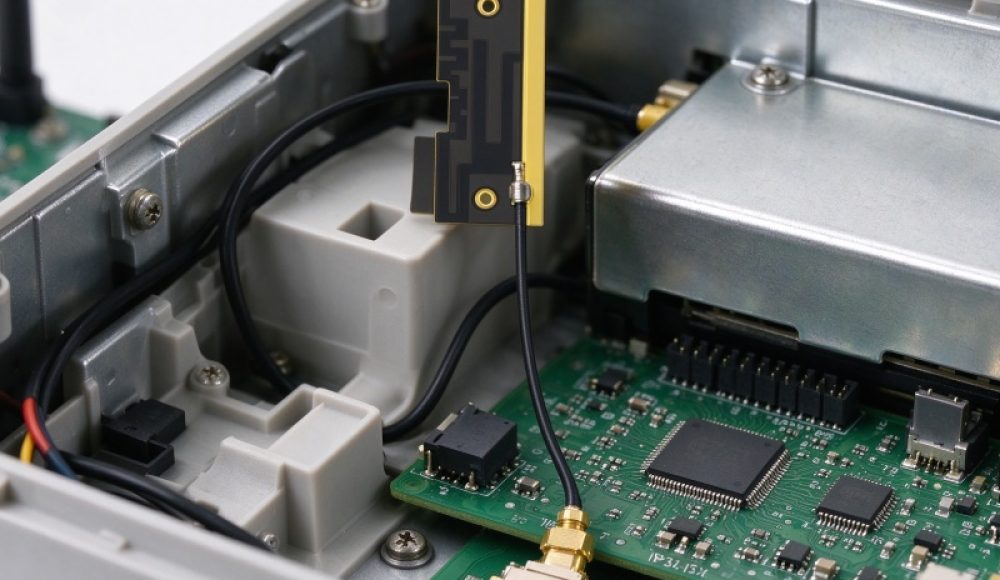
Renfeng’s Wideband NB IoT FPC Antenna is a flexible internal RF component designed for multi-band cellular IoT devices. It supports 824–960MHz and 1710–2170MHz, provides 3dBi gain, and features a 50 × 17mm FPC element, IPEX-1 connector, and 124mm RF1.13 cable.
What Is a Wideband NB IoT FPC Antenna?
A Wideband NB IoT FPC Antenna is a flexible printed circuit antenna designed to support wireless communication across multiple cellular frequency ranges. It allows compact IoT devices to integrate cellular connectivity without requiring separate antenna structures for every supported band. The term is defined as an internal RF antenna that uses a flexible substrate and conductive pattern to transmit and receive radio frequency signals. Its thin structure supports installation in devices with limited internal space or complex layouts.
Renfeng’s NB-IoT/GSM/3G 3dBi Wideband FPC Embedded Antenna operates at 824–960MHz and 1710–2170MHz. These frequency ranges cover several cellular band allocations used by NB-IoT, GSM, and 3G technologies, depending on the communication module and target market.
The main advantages include:
- Multi-band frequency coverage through one antenna structure.
- Compact 50 × 17mm FPC element for internal installation.
- IPEX-1 connector for RF module integration.
- 124mm RF1.13 cable with support for customized cable lengths.
How Does a Multi-Band FPC Antenna Work?
A Multi-Band FPC Antenna converts electrical signals into electromagnetic waves during transmission and converts received radio waves into electrical signals. Its conductive pattern and impedance characteristics determine how it performs across different frequency ranges.
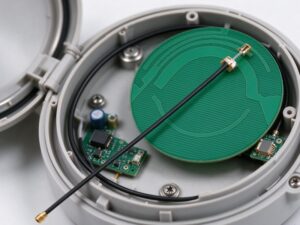
Engineers design the antenna structure to support the required bands while considering the device’s available space and RF circuit layout. They also evaluate impedance matching, ground plane interaction, and nearby electronic components. For example, batteries, metal enclosures, and circuit boards can influence antenna performance. Therefore, engineers should test the antenna inside the complete device rather than relying only on its standalone specifications.
What Are the Key Specifications of This NB-IoT Embedded Antenna?
The Renfeng NB-IoT Embedded Antenna combines dual-range frequency coverage, 3dBi gain, and a compact flexible structure for internal cellular connectivity.
| Parameter | Specification |
|---|---|
| Product Name | NB-IoT/GSM/3G 3dBi Wideband FPC Embedded Antenna |
| Operating Frequency | 824–960MHz / 1710–2170MHz |
| Antenna Gain | 3dBi |
| FPC Element Size | 50 × 17mm |
| Connector | IPEX-1 |
| Cable | 124mm RF1.13 |
| Installation | Internal device mounting |
| Customization | Device-level installation and cable length |
The 3dBi gain rating provides a reference for antenna performance. However, engineers should evaluate it alongside radiation patterns, antenna efficiency, polarization, and the installed device environment.
The IPEX-1 connector links the antenna to a compatible cellular module, while the 124mm RF1.13 cable provides flexibility during internal installation. Engineers can also specify a different cable length according to the device structure.
Which Devices Can Use a GSM 3G Antenna with Wideband Coverage?
A GSM 3G Antenna with wideband coverage can support cellular IoT products when its operating frequency ranges match the communication module and target network.
Typical applications include:
- NB-IoT terminals: Smart meters, remote monitoring devices, and low-power sensor nodes.
- GSM equipment: Cellular monitoring terminals and compatible communication modules.
- 3G devices: Embedded communication products operating on supported 3G networks.
- Industrial IoT equipment: Remote data collection terminals and wireless controllers.
- Smart hardware: Compact connected products that require internal antenna installation.
However, cellular network availability differs by region. Developers should confirm whether NB-IoT, GSM, and 3G services remain available in their target markets before selecting an antenna.
How Should Engineers Choose a Wideband FPC Antenna?
Engineers should select a Wideband FPC Antenna according to frequency coverage, physical dimensions, connector compatibility, cable routing, and RF performance.
The following factors help guide the selection process:
- Frequency compatibility: Match the antenna’s operating ranges with the cellular bands supported by the communication module.
- Installation space: Confirm that the 50 × 17mm FPC element fits the available internal mounting area.
- Connector compatibility: Check whether the IPEX-1 interface matches the module’s RF connection.
- Cable requirements: Evaluate whether the 124mm RF1.13 cable provides sufficient routing length.
- Device environment: Consider nearby batteries, metal components, displays, and circuit boards.
- RF verification: Test impedance matching, efficiency, and radiation characteristics after installation.
A 3dBi FPC Antenna should not be selected based on gain alone. Its suitability depends on the complete device structure and intended operating conditions.
How Does a Wideband FPC Antenna Compare with Other Antenna Types?
A Wideband FPC Antenna provides flexible internal installation and multi-band coverage, while other antenna types offer different mounting and integration characteristics.
| Antenna Type | Main Characteristics | Key Consideration |
|---|---|---|
| Wideband FPC Antenna | Flexible structure and multiple frequency ranges | Requires suitable internal placement |
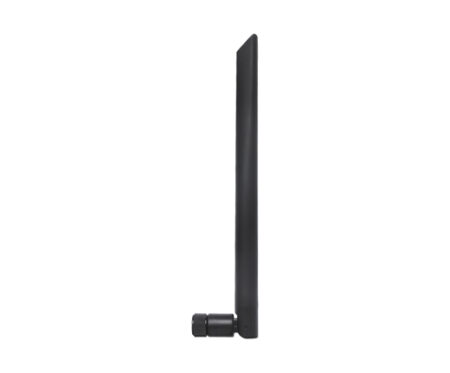
| External Whip Antenna | External mounting and flexible positioning | Requires enclosure access |
| Rigid PCB Antenna | Fixed structure integrated with a PCB | Depends on PCB layout and ground plane |
| Single-Band FPC Antenna | Designed for a specific frequency range | May require additional antennas for other bands |
Compared with traditional solutions that use separate antennas for different frequency ranges, a Multi-Band FPC Antenna can simplify internal integration when one design meets the device’s RF requirements.
Nevertheless, external antennas may offer more placement flexibility when the device enclosure limits internal antenna performance. Engineers should compare the available installation space and RF test results before making a final decision.
What Affects the Cost of a Custom Wideband FPC Antenna?
The cost of a custom wideband antenna depends on RF design requirements, FPC dimensions, connector selection, cable configuration, and production quantity.
The main cost factors include:
- Frequency requirements: Different operating bands may require specific antenna structures and RF tuning.
- FPC design: Element dimensions and conductive patterns influence design complexity.
- Connector and cable: Connector type, cable material, and customized cable length affect component costs.
- Device integration: Different enclosure structures may require additional engineering evaluation.
- Production quantity: Prototype development and mass production involve different preparation and manufacturing requirements.
Providing frequency bands, device dimensions, connector specifications, and expected production quantities helps suppliers evaluate the project more accurately.
How Should Engineers Test a Wideband NB-IoT FPC Antenna?
Engineers should verify antenna performance through RF measurements and device-level communication testing under the intended operating conditions.
Common evaluation methods include:
- S11 and return loss testing: A vector network analyzer measures impedance matching across the operating frequency ranges.
- VSWR testing: Engineers evaluate voltage standing wave ratio to assess impedance matching.
- Radiation pattern testing: Anechoic chamber measurements help evaluate radiation characteristics.
- Antenna efficiency testing: Engineers measure radiation efficiency under defined test conditions.
- Device-level testing: Cellular communication tests help assess antenna performance inside the final enclosure.
The exact test plan should follow the product specification and target application. Certification and compliance requirements also depend on the destination market. Buyers should confirm applicable standards and certification status through relevant project documentation rather than assuming that antenna specifications guarantee regulatory approval.
FAQ: What Should Buyers Know About Wideband NB-IoT FPC Antennas?
What Is a Wideband NB IoT FPC Antenna Used For?
A Wideband NB IoT FPC Antenna provides internal cellular connectivity for compact IoT devices. It supports multiple frequency ranges and can serve compatible NB-IoT, GSM, and 3G applications.
How to Choose a Multi-Band FPC Antenna for Cellular IoT Devices?
Compare the antenna’s frequency coverage with the communication module, then check its dimensions, connector, cable length, and RF performance. Engineers should also verify compatibility with the target cellular networks.
Why Does Antenna Placement Affect Wireless Connectivity?
Antenna placement affects impedance matching, radiation patterns, and signal efficiency. Nearby batteries, metal structures, and circuit boards can influence RF performance, so engineers should evaluate the antenna inside the complete device.
Source & Expertise
This article references the product specifications of Renfeng’s NB-IoT/GSM/3G 3dBi Wideband FPC Embedded Antenna. Renfeng focuses on smart communication terminal antennas and customized RF antenna solutions. Its product range includes FPC antennas, PCB antennas, embedded antennas, and other wireless communication antenna components.
The company has experience in antenna research and development, with RF engineers averaging more than 10 years of industry experience. Its technical capabilities cover concept development, RF design, product customization, and production delivery. Renfeng also provides device-level integration support for different frequency requirements and equipment structures.
Certification requirements depend on the final product and destination market. Buyers should request relevant test reports and certification documents when evaluating a specific product. No unverified certification or test result is claimed in this article.
Last Updated: November 2, 2026