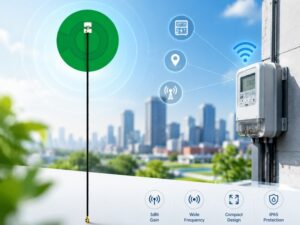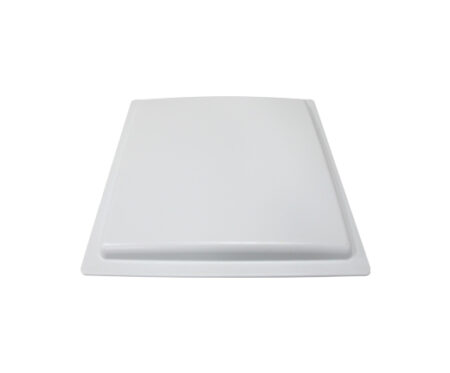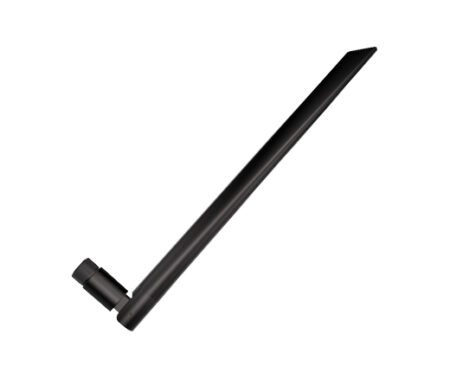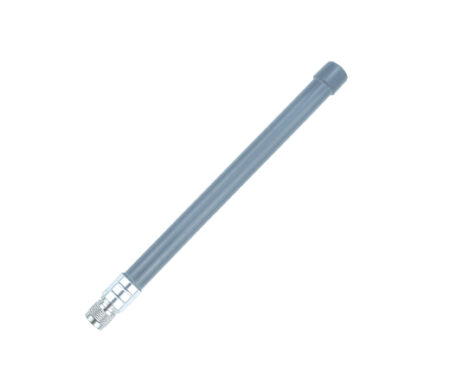

Modern wireless networks need antennas that can support multiple frequency bands without requiring frequent hardware changes. As 4G, 5G, LoRa, IoT, and industrial wireless applications continue to expand, network designers often need flexible antenna solutions for different communication environments. A wideband omnidirectional antenna can address this requirement by covering a broad frequency range while providing 360-degree horizontal signal coverage. This combination makes it useful for base stations, outdoor communication systems, IoT gateways, and temporary field deployments. Furthermore, broad frequency coverage can simplify antenna selection when one system needs to support different wireless technologies.
600–6000MHz Wide Frequency Coverage
The featured antenna covers 600–6000MHz, providing a broad operating range for compatible wireless systems. Such coverage can support applications across lower-frequency cellular bands and higher-frequency wireless services. Therefore, network designers can use one antenna platform for different deployment requirements instead of relying on several antennas with narrower frequency ranges. However, the actual usable frequency bands depend on the connected equipment and regional network standards. Moreover, wideband antenna design requires careful control of impedance, radiation characteristics, and overall structure. Stable performance across a broad frequency range is important for maintaining predictable wireless communication.
How Omnidirectional Radiation Supports 4G and 5G
An omnidirectional antenna distributes radio energy around the antenna horizontally, creating a 360-degree coverage pattern. Consequently, it can communicate with devices positioned in different directions without requiring the antenna to point toward a specific target. This characteristic is particularly useful for outdoor base stations, industrial sites, public areas, and IoT deployments where users or devices may be distributed around the antenna. For 4G and 5G networks, an omnidirectional structure can provide broad coverage when the deployment architecture and network requirements are suitable. Therefore, it can be a practical option for communication systems that prioritize wide-area connectivity.
Selectable 6–10dBi Gain
The antenna supports selectable gain values from 6dBi to 10dBi, allowing system designers to choose a configuration according to coverage and installation requirements. Lower gain can provide a broader vertical radiation pattern, which may be useful for certain installations. In contrast, higher gain can concentrate more energy in the horizontal direction and may help extend coverage in suitable environments. As a result, selectable gain provides greater flexibility when deploying antennas at different heights or across different site layouts.
Key Features
The main characteristics of this antenna include:
- 600–6000MHz wideband coverage: Supports a broad range of compatible wireless applications.
- 360-degree omnidirectional radiation: Provides horizontal coverage around the antenna.
- Selectable 6–10dBi gain: Offers flexibility for different coverage requirements.
- Outdoor-ready construction: Designed for field and outdoor wireless deployments.
- Multiple application options: Suitable for cellular, LoRa, IoT, and industrial networks.
- Flexible customization: Gain, connector, mounting bracket, radome material, and color can be adjusted.
Together, these features make the antenna adaptable to various wireless infrastructure projects.
Wideband Omnidirectional vs. Narrowband Antennas
A narrowband antenna is designed to operate efficiently within a relatively limited frequency range. It can provide optimized performance for a specific wireless band, but changing network requirements may require additional antenna hardware. In contrast, a wideband omnidirectional antenna covers a much broader frequency range while maintaining an omnidirectional radiation pattern. This can simplify system design when several wireless technologies need to share an antenna platform.
| Feature | Wideband Omnidirectional Antenna | Narrowband Antenna |
|---|---|---|
| Frequency Coverage | Broad | Limited |
| Horizontal Coverage | 360° | Depends on design |
| Multi-Technology Use | More flexible | Usually application-specific |
| Installation Flexibility | High | Moderate |
| Typical Applications | 4G/5G, IoT, LoRa | Dedicated wireless bands |
The appropriate antenna depends on the required frequency bands, coverage pattern, gain, installation environment, and network architecture.
Applications in 4G and 5G Networks
4G and 5G infrastructure may require different antenna configurations depending on coverage goals and site conditions. Outdoor communication systems can benefit from an antenna that supports multiple compatible frequency ranges. For example, the antenna can be considered for base stations, private wireless networks, field communication systems, and temporary connectivity installations. Furthermore, the omnidirectional pattern can provide coverage to devices distributed around the installation point. However, network operators should always verify frequency compatibility and local regulatory requirements before deployment.
Supporting LoRa and IoT Gateways
IoT networks often connect many distributed devices over relatively large areas. Consequently, antenna coverage and installation height can influence the overall communication range. The broad 600–6000MHz operating capability allows the antenna to support different compatible wireless platforms. LoRa gateways, for example, can benefit from an antenna configuration selected according to their operating frequency and coverage requirements. Similarly, industrial IoT gateways may use omnidirectional antennas to communicate with sensors positioned across a facility. This makes the design useful for applications where devices are not concentrated in one direction.
Public Safety and Industrial Wireless Applications
Reliable wireless coverage is also important for public safety and industrial communication systems. These environments may include large outdoor areas, equipment yards, warehouses, transportation facilities, and remote field locations. An omnidirectional radiation pattern can provide communication coverage around the installation point. Therefore, it may be suitable for systems where connected devices move between different directions. In addition, rugged outdoor construction can support field deployments where equipment may be exposed to changing weather and environmental conditions.
Customization for Different Deployments
Wireless infrastructure projects often have different mechanical and installation requirements. Therefore, a standard antenna configuration may not always provide the best fit. Customization options can include gain value, connector type, mounting bracket, radome material, and color. As a result, the antenna can be adapted to different equipment interfaces and installation structures. Furthermore, selecting the appropriate mounting solution can help ensure that the antenna is positioned correctly for the intended coverage area.
Installation Considerations
Antenna performance depends not only on its electrical design but also on installation conditions. Nearby buildings, metal structures, trees, and other obstacles can affect signal propagation. Therefore, installers should consider antenna height, surrounding objects, cable routing, connector compatibility, and grounding requirements. Proper placement can help the antenna achieve a more predictable coverage pattern. Moreover, the selected gain should match the installation height and desired coverage area rather than simply choosing the highest available value.
Why Choose Renfeng?
Renfeng provides antenna solutions for cellular communication, IoT, industrial wireless systems, and other specialized applications. Its wideband outdoor antenna platform combines broad frequency coverage, selectable gain, and 360-degree radiation. Furthermore, flexible customization options allow the antenna to be configured according to connector, mounting, housing, and appearance requirements. This makes it easier to adapt the antenna to different wireless infrastructure projects.
A Flexible Solution for Modern Wireless Networks
As wireless systems become more diverse, antenna flexibility becomes increasingly important. A broad operating range can help support multiple technologies, while omnidirectional radiation provides practical 360-degree horizontal coverage. With 600–6000MHz coverage and selectable 6–10dBi gain, this antenna is designed for compatible 4G, 5G, LoRa, IoT, public safety, and industrial wireless applications.
Ultimately, the right antenna should be selected according to frequency requirements, coverage objectives, installation conditions, and network architecture. With proper configuration and installation, a wideband omnidirectional antenna can provide a flexible foundation for modern outdoor wireless communication systems.