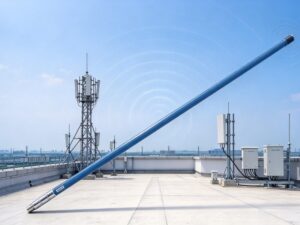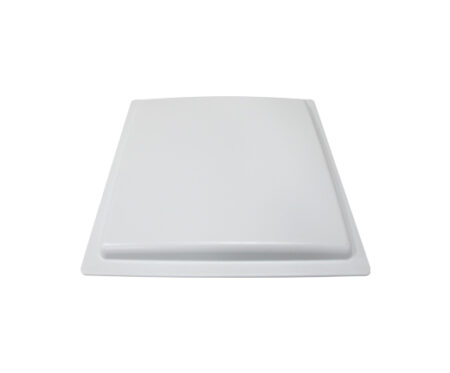
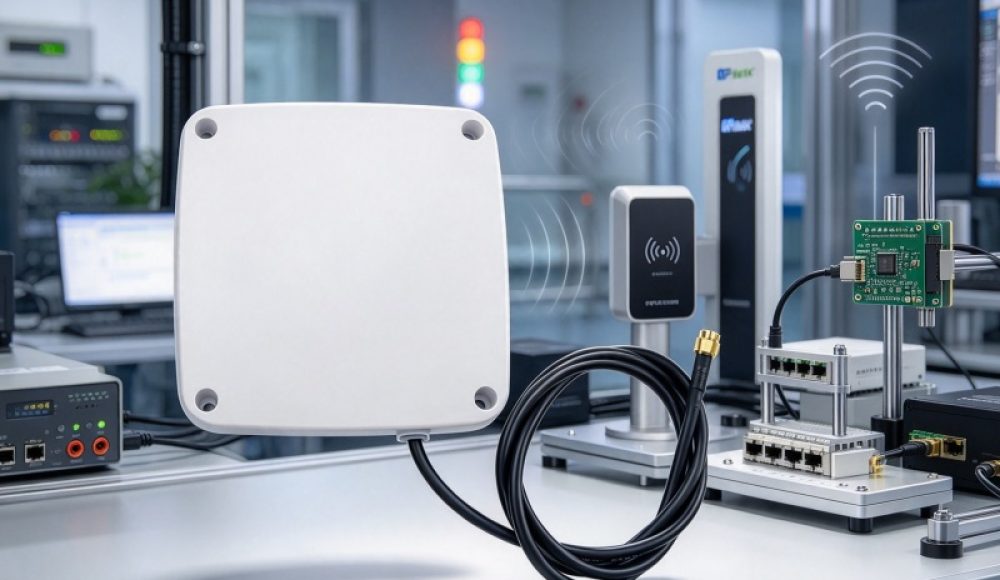
A Circularly Polarized RFID Panel Antenna helps RFID systems identify tagged items across defined reading zones, supporting inventory counting, warehouse tracking, and asset management. Renfeng’s 850–960MHz 6dBi Circular Polarized RFID Panel Antenna features circular polarization, an SMA connector, 50W power handling, and a compact 134 × 134 × 21mm design.
What Is a Circularly Polarized RFID Panel Antenna?
A Circularly Polarized RFID Panel Antenna is an antenna that transmits or receives radio-frequency signals with circular polarization to communicate with compatible RFID tags. It typically serves as part of an RFID reader system, helping detect tagged products or assets within a designated coverage area.
Unlike a system that relies on manual barcode scanning, RFID technology can identify multiple tags without requiring direct visual contact. However, reading performance depends on the reader, tag design, antenna placement, surrounding materials, and operating environment.
Renfeng’s 850–960MHz 6dBi Circular Polarized RFID Panel Antenna provides the following specifications:
| Parameter | Product Specification |
|---|---|
| Product type | RFID panel antenna |
| Operating frequency | 850–960MHz |
| Gain | 6dBi |
| Polarization | Circular polarization |
| Connector | SMA |
| Power handling | 50W |
| Dimensions | 134 × 134 × 21mm |
These specifications help system integrators evaluate the antenna’s compatibility with their RFID equipment. Before deployment, engineers should also confirm regional frequency requirements and the reader’s supported connector and antenna interface.
How Does Circular Polarization Improve RFID Inventory Tracking?
Circular polarization can improve tag-reading flexibility when RFID tags appear at different rotational angles, provided the tags and reader system use compatible polarization arrangements.
In a warehouse, products may sit in cartons, move along conveyor belts, or enter a reading zone in different orientations. A linearly polarized antenna may experience polarization mismatch when a tag rotates relative to the antenna. Circular polarization can reduce sensitivity to that rotational mismatch, although it does not eliminate every source of missed reads.
The main advantages include:
- More flexible tag orientation: Circular polarization can support reading when tags rotate within the antenna’s coverage area.
- Defined reading zones: Panel antennas can direct coverage toward shelves, workstations, conveyor sections, or access points.
- Automated identification: RFID readers can collect tag responses without requiring operators to scan every item individually.
- Integration flexibility: The antenna can form part of a larger inventory or asset-tracking system.
Actual read rates still depend on tag sensitivity, antenna placement, reader settings, interference, and nearby metal or liquid materials.
Where Can an RFID Panel Antenna Be Used?
An RFID panel antenna can support inventory and identification tasks in warehouses, distribution centers, retail operations, and controlled access areas.
Common applications include:
- Warehouse inventory: Identify tagged goods at storage locations or designated counting points.
- Conveyor tracking: Read tags as products pass through a configured inspection zone.
- Retail inventory management: Help reconcile tagged merchandise and monitor stock movement.
- Asset tracking: Identify tagged tools, equipment, containers, and reusable assets.
- Access control: Support RFID identification at entry points when the complete system matches the required tag and access-control standards.
For each application, engineers should define the intended read zone before selecting the antenna. A wider reading area does not always produce better results because it can also capture tags outside the intended zone.
How Should You Choose an RFID Panel Antenna?
To choose an RFID panel antenna, first confirm frequency compatibility, polarization, gain, connector type, installation conditions, and the required reading zone.
Use these factors during system design:
- Frequency compatibility: Confirm that the antenna’s operating range matches the RFID reader, tags, and regional frequency regulations. The 850–960MHz range requires particular attention to the intended operating band.
- Polarization: Consider whether tags remain in a fixed orientation or rotate during handling. Circular polarization may help when tag orientation varies.
- Gain and coverage: Evaluate antenna gain alongside beam pattern, mounting height, distance, and surrounding obstacles. Gain alone does not determine the usable reading area.
- Connector and power: Verify the SMA connection and ensure the reader’s output stays within the antenna’s rated 50W power-handling capacity.
- Installation environment: Assess metal shelving, liquids, moving equipment, and adjacent RFID zones because they can affect RF propagation and tag detection.
- System testing: Test representative tags and products under real operating conditions before finalizing the installation.
These checks help engineers match the antenna to the application rather than choosing a product based on one specification alone.
How Does a Panel Antenna Compare With Other RFID Antennas?
Compared with traditional solutions that rely on manual scanning or a single antenna arrangement, a panel antenna can support a fixed RFID reading zone for automated identification. However, the most suitable antenna depends on the system layout and tracking objective.
| Antenna or Method | Typical Strength | Main Consideration |
|---|---|---|
| Circularly polarized panel antenna | Can accommodate varied tag orientations | Placement and reading-zone testing remain necessary |
| Linearly polarized antenna | Can suit consistently aligned tags | Polarization mismatch may affect rotated tags |
| Near-field RFID antenna | Can support localized identification | Requires a suitable close-range application |
| Manual barcode scanning | Provides direct, item-by-item confirmation | Requires operator action and visual access |
The comparison describes general application characteristics, not guaranteed performance. Engineers should compare measured read rates, unwanted reads, coverage, and installation costs within the intended environment.
What Factors Affect RFID Antenna Costs?
RFID antenna costs depend on electrical design, materials, mechanical construction, connector requirements, customization, order quantity, and quality-control procedures.
Other project costs may include mounting hardware, coaxial cables, reader equipment, installation labor, integration, and site testing. Therefore, buyers should compare the complete system requirements rather than evaluating antenna prices alone.
For custom projects, define the frequency range, gain, polarization, dimensions, connector, environmental conditions, and expected deployment volume before requesting a quotation.
How Does Renfeng Support RFID Antenna Projects?
Renfeng provides antenna design and customization support for wireless equipment and communication projects, covering requirement discussions, RF design, manufacturing, and delivery coordination. Its project workflow can help system integrators communicate application requirements and evaluate antenna configurations for inventory management, asset identification, and other wireless deployments. However, the suitability of any configuration depends on the specific project requirements and verification results.
When evaluating a supplier, buyers should confirm its relevant manufacturing experience, engineering resources, quality-control process, and ability to provide required documentation. No specific certification, accredited test report, or named RFID compliance standard was provided for this product. Customers should therefore request applicable certificates and test records directly when their project requires them.
What Should Engineers Test Before Deploying an RFID Antenna?
Engineers should verify RF performance, reader compatibility, tag-reading consistency, and coverage under representative operating conditions before deployment.
A practical verification plan may include:
- Frequency response across the intended operating band.
- Return loss and VSWR measurements against the project’s acceptance criteria.
- Gain and radiation-pattern verification where required.
- Connector compatibility and cable-loss checks.
- Read-rate testing with representative tags, packaging, and product orientations.
- Interference and unwanted-read assessments across adjacent reading zones.
- Compliance checks against applicable regional radio regulations and project requirements.
Test limits should come from the product documentation, system design, and applicable standards. No measured VSWR, return-loss value, radiation-pattern report, or named certification standard was supplied for Renfeng’s antenna, so these results should not be assumed.
What Are the Most Common Questions About RFID Panel Antennas?
What Is a Circularly Polarized RFID Panel Antenna?
A Circularly Polarized RFID Panel Antenna is an RFID antenna that uses circular polarization to transmit or receive radio signals. It can help identify tagged items when tag orientation varies, subject to system compatibility and the surrounding RF environment.
How to Choose an RFID Antenna for Warehouse Tracking?
Choose an RFID antenna by matching its frequency range, polarization, gain, connector, and coverage to the reader, tags, and warehouse layout. Then test read consistency and unwanted reads using representative products.
Why Use Circular Polarization for Asset Tracking?
Circular polarization can reduce sensitivity to tag rotation compared with a linearly polarized arrangement in suitable configurations. It does not guarantee longer read range or eliminate interference, so engineers should validate performance in the actual installation.
What Sources and Expertise Support This Article?
This article uses the product specifications and company capabilities supplied for Renfeng’s 850–960MHz 6dBi Circular Polarized RFID Panel Antenna. The application examples and testing recommendations reflect general RFID system-design principles. No independent test report, certification record, or third-party performance data was supplied for verification.
When Was This Article Last Updated?
Last Updated: October 19, 2026.