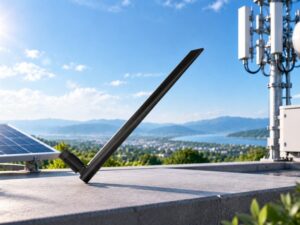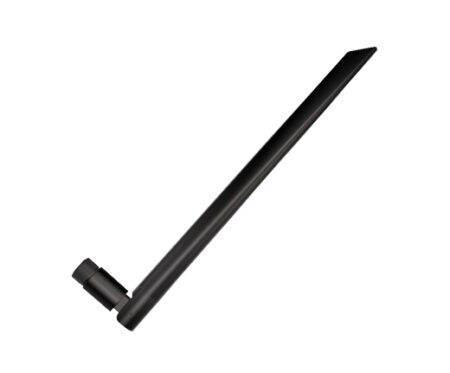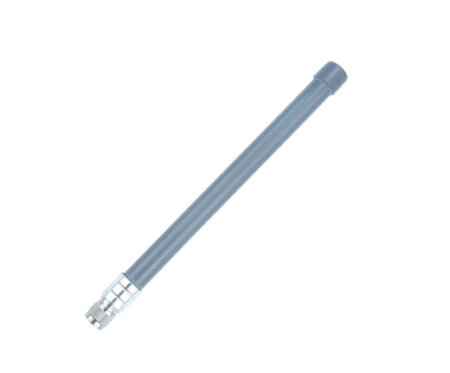

LoRa technology enables long-range, low-power wireless communication for applications such as smart agriculture, environmental monitoring, industrial automation, and smart city infrastructure. However, the performance of a LoRa gateway depends on more than the communication protocol alone, as antenna characteristics, installation height, surrounding obstacles, and radio configuration all affect signal transmission. An 868MHz wideband magnetic mount antenna is relevant to compatible wireless systems designed to operate in the 868MHz band, where permitted by local regulations. By selecting an antenna that matches the radio equipment and deployment requirements, network operators can establish a more suitable foundation for communication between gateways and remote sensor nodes.
How 6dBi Gain Can Affect LoRa Gateway Coverage
Antenna gain describes how an antenna distributes radio energy in a particular direction compared with a reference antenna. A 6dBi high gain antenna may concentrate energy more strongly toward certain angles than a lower-gain model, depending on its radiation pattern. Consequently, it may improve signal strength in suitable installations and help extend coverage along the directions where its radiation pattern provides sufficient energy. Nevertheless, higher gain does not automatically guarantee a longer communication range in every environment, because terrain, buildings, interference, antenna orientation, and regulatory transmission limits also influence performance. Therefore, engineers should evaluate antenna gain together with the intended coverage area and the radio system’s link budget.
Why a Magnetic Mount Antenna Offers Installation Flexibility
A magnetic mount antenna provides a convenient way to position an antenna on a compatible metal surface without necessarily drilling holes or installing a permanent mounting bracket. This approach is useful during deployment testing because installers can adjust the antenna’s location to compare signal conditions and find a suitable mounting position. In addition, the magnetic base can simplify installation on certain equipment housings or vehicle surfaces when the application permits this arrangement. However, users should confirm mounting stability, cable routing, and environmental suitability before installation, particularly where vibration or outdoor exposure may occur. Proper positioning also matters because nearby metal structures and other obstacles can affect the antenna’s radiation characteristics.
Key Factors That Influence LoRa Antenna Performance
Although antenna gain is important, reliable LoRa connectivity depends on several elements working together. First, the antenna must support the operating frequency of the radio module, since a mismatch can reduce system performance. Second, installation height, cable quality, connector compatibility, and nearby obstructions can influence the quality of the radio link. Furthermore, receiver sensitivity, transmission power, and interference affect how reliably a gateway communicates with remote devices. For this reason, choosing a LoRa antenna requires evaluating the complete wireless setup rather than relying on a single specification.
When comparing antenna options, consider the following factors:
-
Frequency compatibility: Confirm that the supported frequency range matches the intended operating band and local regulations.
-
Gain and radiation pattern: Evaluate how the antenna distributes radio energy across the target coverage area.
-
Mounting location: Choose a suitable position that reduces unnecessary obstruction from nearby structures.
-
Connector and cable: Check connector compatibility and consider cable loss when planning the installation.
-
Environmental conditions: Assess mounting stability, vibration, moisture exposure, and other site-specific requirements.
-
Field testing: Test signal performance at representative device locations before completing a large-scale deployment.
Comparing Important Antenna Selection Factors
The table below summarizes several factors that engineers and purchasing teams should review when selecting an antenna for a LoRa gateway.
| Selection factor | What to evaluate | Why it matters |
|---|---|---|
| Operating frequency | Compatibility with the target band | Supports appropriate antenna operation |
| Antenna gain | Gain value and radiation pattern | Influences signal distribution and coverage |
| Mounting method | Magnetic base and surface compatibility | Affects installation flexibility and stability |
| Connector type | Compatibility with the gateway interface | Supports correct equipment integration |
| Cable length | Cable type and expected signal loss | Helps manage losses between the radio and antenna |
| Installation position | Height, obstacles, and nearby structures | Influences radio propagation |
| Regulatory requirements | Permitted frequencies and transmission limits | Helps maintain compliant operation |
Understanding 868MHz and 915MHz Antenna Applications
An 868MHz antenna and a 915MHz antenna serve different frequency requirements, even though both may be used in sub-GHz wireless communication systems. The appropriate option depends on the radio module, the antenna’s specified frequency range, the intended application, and regional regulations. For example, many LoRa deployments in European markets use the 868MHz band, while some other regions use frequencies around 915MHz. Therefore, engineers should verify the required operating band before selecting a magnetic mount antenna, rather than assuming that one model will support both frequencies. Matching the antenna to the intended radio system helps avoid compatibility problems and supports more predictable deployment planning.
Practical Steps for Improving LoRa Gateway Range
Improving gateway coverage usually requires a combination of antenna selection, careful placement, and system testing. First, position the antenna where surrounding obstacles have less impact on the radio path, while maintaining a stable mounting arrangement. Next, check connector integrity and cable specifications to reduce avoidable losses. Finally, measure signal performance at representative locations and adjust the installation when necessary. These steps help engineers identify practical coverage limitations instead of assuming that antenna gain alone will determine the final result.
Conclusion
Antenna selection plays an important role in LoRa network planning because frequency compatibility, gain, radiation pattern, and mounting position all influence wireless performance. A magnetic mounting design can provide installation flexibility, while a 6dBi gain rating may benefit applications where its radiation characteristics suit the required coverage area. However, actual range also depends on terrain, interference, radio configuration, cable loss, and local transmission limits. Renfeng supports antenna sourcing for wireless communication projects by helping business customers consider frequency requirements, connector interfaces, and installation needs. By verifying the product specifications and testing the complete system under real operating conditions, network operators can make more informed decisions when building LoRa gateway deployments.