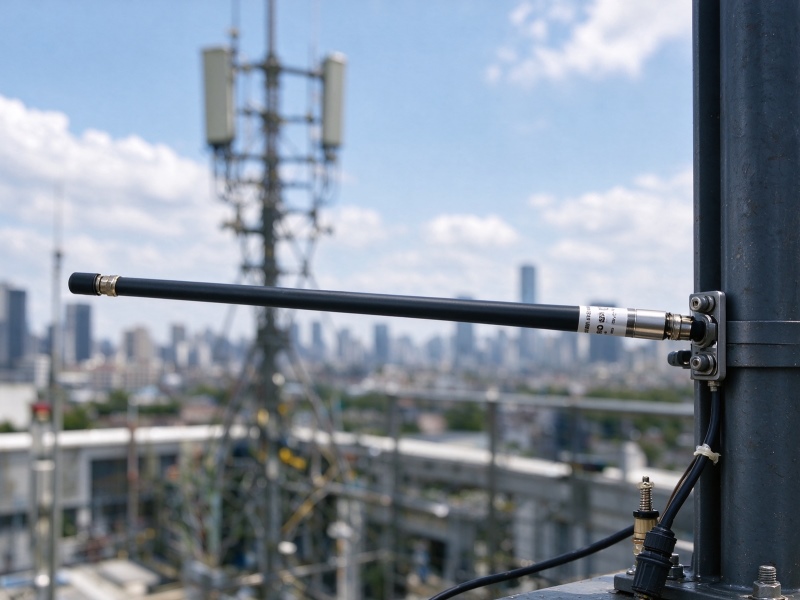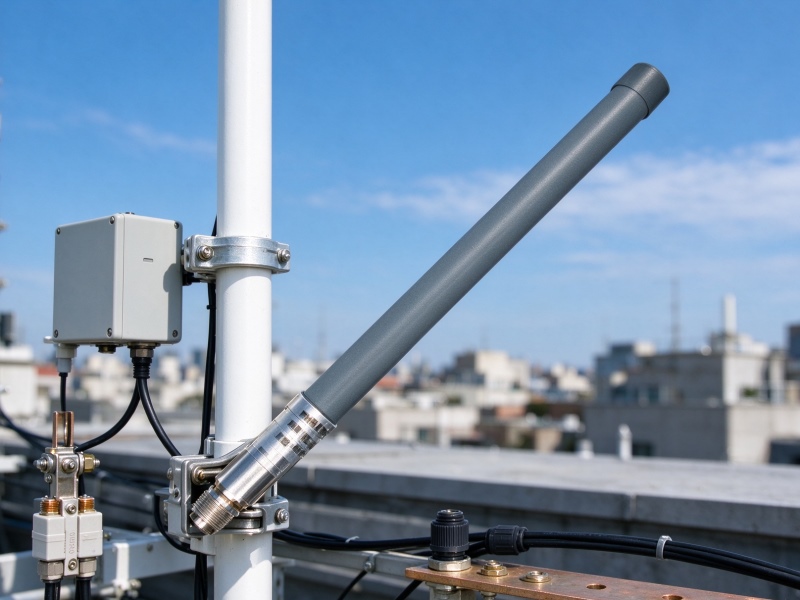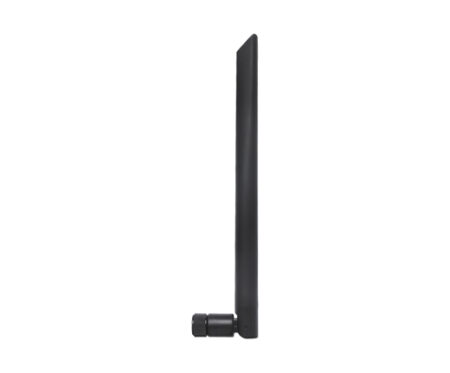

Renfeng’s 868MHz Fiberglass LoRa Antenna is an outdoor omnidirectional antenna designed for long-range LoRa gateway communication. It operates across 850–940MHz, with a center frequency of 868MHz and 9dBi gain. Its vertical polarization, N Male connector, 50W power handling, and 850mm length support fixed outdoor wireless installations.
What Is an 868MHz Fiberglass LoRa Antenna?
An 868MHz Fiberglass LoRa Antenna is an external RF antenna designed to support LoRa communication around the 868MHz frequency band. It converts electrical RF signals into electromagnetic waves during transmission and performs the reverse process during reception.
The product discussed here is the Renfeng 868MHz 9dBi Long-Range Omnidirectional Fiberglass Antenna. Its main specifications include:
- Frequency range: 850–940MHz
- Center frequency: 868MHz
- Gain: 9dBi
- Polarization: Vertical
- Connector: N Male
- Power handling: 50W
- Antenna length: 850mm
The fiberglass radome protects the internal antenna structure and provides an external housing suitable for outdoor installation. However, the specific weatherproof rating and environmental test results should be confirmed through the product datasheet.
How Does Its Antenna Design Improve Outdoor Coverage?
The antenna improves outdoor communication by converting RF energy efficiently and distributing signals around its vertical axis. Its gain, polarization, frequency compatibility, and installation position all influence the resulting coverage.
How Does 9dBi Gain Affect Signal Coverage?
A 9dBi gain rating indicates that the antenna concentrates more RF energy in certain directions than a lower-gain antenna under comparable measurement conditions. This characteristic can support longer communication links when the gateway, receiver, and surrounding environment are properly matched.
However, higher gain does not automatically guarantee greater coverage in every direction. A high-gain omnidirectional antenna generally has a narrower vertical radiation pattern than a lower-gain model. Therefore, engineers should consider the height and elevation of remote devices before selecting an antenna.
Why Does Omnidirectional Coverage Matter?
An Omnidirectional Antenna distributes RF energy around its vertical axis, making it useful when wireless nodes are positioned in different horizontal directions.
The main advantages include:
- Coverage across multiple horizontal directions.
- No need to point the antenna toward every individual node.
- Practical integration with fixed LoRa gateways.
- Suitability for distributed monitoring devices in outdoor areas.
Compared with traditional directional solutions, an omnidirectional design reduces the need for precise horizontal alignment when communicating with multiple devices around one gateway. Nevertheless, terrain, obstacles, antenna height, and local interference still affect actual communication distance.
How Does Vertical Polarization Affect LoRa Links?
Vertical polarization helps match the antenna to remote devices that also use vertically polarized antennas. When the transmitting and receiving antennas have different polarization orientations, polarization mismatch can reduce received signal strength.
For this reason, installation teams should check the polarization of both ends of the communication link before deployment.
What Are the Main Specifications of This Fiberglass Antenna?
The following table summarizes the confirmed product parameters and explains their practical relevance.
| Parameter | Specification | Practical relevance |
|---|---|---|
| Frequency range | 850–940MHz | Covers the specified operating band |
| Center frequency | 868MHz | Targets 868MHz wireless applications |
| Gain | 9dBi | Supports higher directional concentration |
| Polarization | Vertical | Matches vertically polarized RF links |
| Connector | N Male | Provides an external RF connection |
| Power handling | 50W | Defines the stated maximum power capacity |
| Length | 850mm | Affects mounting space and installation planning |
| Antenna type | Omnidirectional fiberglass | Supports communication in multiple horizontal directions |
The frequency range is particularly important because regional LoRa deployments use different sub-GHz allocations. Engineers should verify local frequency regulations and radio module compatibility before installation.
Where Can an Outdoor LoRa Antenna Be Used?
An outdoor fiberglass antenna can support fixed wireless communication systems that need to connect distributed devices across open or semi-open areas.
Common applications include:
- LoRa gateway networks: Connecting gateways with distributed sensor nodes.
- Smart agriculture: Supporting communication with soil, weather, and irrigation monitoring devices.
- Industrial monitoring: Connecting remote equipment and environmental sensors.
- Outdoor fixed communication facilities: Providing RF connectivity for monitoring and telemetry infrastructure.
- Remote monitoring systems: Supporting data transmission from devices installed across large sites.
Actual coverage depends on the radio module’s transmit power, receiver sensitivity, antenna placement, terrain, interference, and applicable regulatory limits. Therefore, the antenna gain alone cannot determine a guaranteed communication distance.
How Should You Choose a Long-Range Outdoor Antenna?
Engineers should evaluate frequency compatibility, gain, radiation pattern, polarization, connector type, and installation conditions before selecting a Long Range Antenna.
The following factors provide a practical selection checklist:
- Frequency compatibility: Confirm that the antenna’s operating range covers the radio module’s target frequency and local allocation.
- Gain requirements: Evaluate whether 9dBi gain suits the required coverage area and the elevation of remote devices.
- Radiation pattern: Check whether omnidirectional coverage or directional transmission better matches the network layout.
- Polarization: Match the antenna polarization with the remote communication equipment.
- Connector compatibility: Confirm that the N Male connector matches the cable or RF interface.
- Installation conditions: Check mounting height, mast compatibility, cable routing, grounding, and exposure to weather.
- Performance verification: Request relevant RF test data, including VSWR, impedance, radiation pattern, and efficiency, when available.
These checks help engineers avoid choosing an antenna based only on its advertised gain.
How Does a Fiberglass Antenna Compare with Other Antenna Types?
A fiberglass antenna, a rubber duck antenna, and a directional Yagi antenna serve different installation and coverage requirements.
| Antenna type | Coverage characteristics | Typical installation |
|---|---|---|
| Fiberglass omnidirectional antenna | Horizontal coverage around the antenna | Outdoor gateways and fixed masts |
| Rubber duck antenna | Compact external coverage | Portable devices and compact terminals |
| Directional Yagi antenna | Concentrated coverage in a specific direction | Point-to-point communication links |
A fiberglass antenna is generally suitable for fixed outdoor installations where devices communicate from multiple horizontal directions. A rubber duck antenna is more practical when equipment size and compact installation matter. A Yagi antenna is more appropriate when the communication target is located in a known direction.
The best choice depends on network topology rather than gain alone.
What Factors Affect the Cost of an Outdoor Fiberglass Antenna?
The cost of an Outdoor Antenna depends on its RF specifications, physical construction, connector configuration, production requirements, and testing scope.
Important cost factors include:
- Frequency range: Wider operating bandwidth may require different antenna design and matching considerations.
- Gain requirements: Higher gain can influence the antenna’s internal structure and overall dimensions.
- Materials and housing: Radome materials and structural components affect manufacturing costs.
- Connector configuration: Different RF connectors and cable arrangements can change component and assembly costs.
- Production quantity: Prototype development and batch production may have different unit costs.
- Testing requirements: Additional RF measurements and environmental validation can affect project costs.
Buyers should compare complete specifications and test documentation rather than evaluating products by price or gain rating alone.
How Does Renfeng Support Fiberglass Antenna Development?
Renfeng is a communication antenna company established in 2012, focusing on intelligent communication terminal antennas and customized antenna solutions. Its RF engineering team has an average of more than 10 years of industry experience.
The company supports antenna projects through several stages:
- Concept development and application assessment.
- RF design and antenna performance evaluation.
- Product development and configuration adaptation.
- Batch production and product delivery.
Renfeng also maintains service support across major regions in China and nearby markets, including Singapore and Vietnam. This support network helps communication equipment companies coordinate antenna development and project requirements.
For this product, the confirmed specifications include 850–940MHz operation, 9dBi gain, vertical polarization, an N Male connector, 50W power handling, and an 850mm antenna length.
Which RF Tests and Standards Should Buyers Check?
Buyers should request product-specific RF test reports and verify applicable regional radio regulations before deploying an antenna in a commercial network.
Relevant technical checks may include:
- VSWR testing: Evaluates impedance matching across the operating frequency range.
- Impedance measurement: Confirms compatibility with the RF system, commonly designed around 50Ω interfaces.
- Gain measurement: Verifies antenna gain under defined test conditions.
- Radiation pattern testing: Shows how the antenna distributes RF energy.
- Polarization testing: Confirms the antenna’s polarization characteristics.
- Environmental testing: Evaluates performance under specified temperature, moisture, and weather conditions.
For radio equipment operating in Europe, buyers may need to review applicable ETSI requirements. In the United States, FCC rules may apply to the radio equipment and its deployment. These regulatory references do not establish that this antenna itself holds a particular certification. Buyers should verify the relevant documentation for the complete radio system and antenna configuration.
FAQ: What Do Buyers Commonly Ask About 868MHz Fiberglass Antennas?
What is an 868MHz fiberglass antenna used for?
An 868MHz fiberglass antenna supports sub-GHz wireless communication, including compatible LoRa gateway and remote monitoring applications. Its operating range, gain, polarization, and mounting configuration determine whether it fits a particular network.
How to choose an antenna for long-range LoRa communication?
Choose an antenna by checking frequency compatibility, gain, radiation pattern, polarization, connector type, and installation height. Also consider the radio module’s transmit power, receiver sensitivity, local regulations, and surrounding terrain.
Why does a 9dBi antenna not always provide greater coverage?
A 9dBi antenna concentrates RF energy more strongly in certain directions, but this may narrow its vertical radiation pattern. If remote devices sit at different elevations, a lower-gain antenna may sometimes provide more suitable coverage.
Source & Expertise
This article uses the product specifications and company information supplied by Renfeng. Technical explanations describe general RF antenna principles and do not replace product-specific test reports.
For engineering evaluation, buyers should request the current datasheet and available measurement reports for gain, VSWR, impedance, radiation pattern, and environmental performance.
Last Updated
November 17, 2026