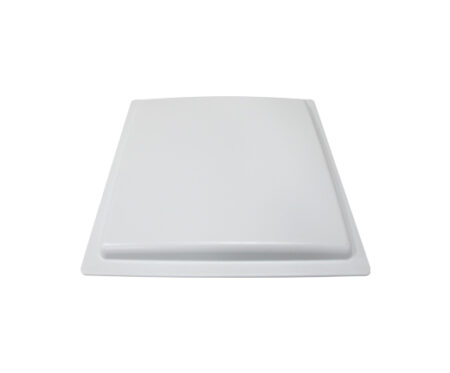
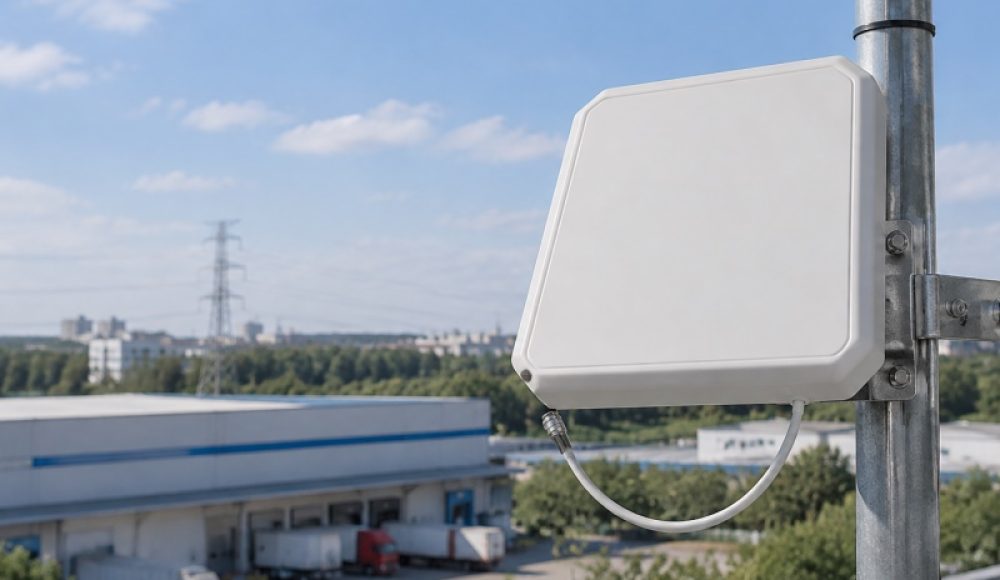
A Circular Polarized RFID Panel Antenna uses circular polarization to read UHF RFID tags with different orientations. Renfeng’s 850–930MHz 12dBi model features an N-type female connector, 50W power handling, and a 258 × 258 × 34mm enclosure. It supports fixed RFID applications such as warehouse inventory, vehicle identification, and asset tracking.
What Is a Circular Polarized RFID Panel Antenna?
A Circular Polarized RFID Panel Antenna is a directional UHF antenna that transmits and receives radio-frequency signals using circular polarization to communicate with RFID tags. Circular polarization is defined as an electromagnetic wave whose electric field rotates as the wave propagates. This characteristic helps RFID readers communicate with tags that have different antenna orientations.
Renfeng’s 850–930MHz 12dBi High-Gain Circular Polarized RFID Panel Antenna is designed for fixed RFID reading applications. Its main specifications include:
| Parameter | Specification |
|---|---|
| Frequency range | 850–930MHz |
| Antenna gain | 12dBi |
| Polarization | Circular |
| Connector | N Female |
| Power handling | 50W |
| Dimensions | 258 × 258 × 34mm |
| Antenna type | Directional panel antenna |
These parameters help engineers evaluate compatibility with UHF RFID readers and fixed identification systems. However, actual reading performance also depends on reader output power, tag sensitivity, antenna placement, and surrounding materials.
How Does Circular Polarization Improve RFID Tag Reading?
Circular polarization improves RFID reading flexibility by reducing dependence on the rotational orientation of a tag antenna.
A conventional linearly polarized antenna produces an electric field that maintains a fixed polarization direction. When the RFID tag antenna and reader antenna have different polarization directions, polarization mismatch can reduce the received signal strength.
A circular polarization antenna rotates its electric field, which can help maintain communication with tags positioned at different rotational angles.
The main advantages include:
- Reduced polarization mismatch: Supports reading tags with varying rotational orientations.
- Directional coverage: Concentrates RF energy toward a designated reading area.
- Flexible tag positioning: Helps accommodate different tag orientations in warehouse and logistics environments.
- Fixed installation: Provides a practical antenna configuration for stationary RFID readers.
However, circular polarization does not eliminate every reading limitation. Tag placement, metallic surfaces, liquid containers, multipath reflections, and antenna alignment can still affect identification performance.
Where Can a Circular Polarized RFID Panel Antenna Be Used?
A Circular Polarized RFID Panel Antenna supports fixed RFID reading applications where tags move through or remain within a defined detection area.
Typical applications include:
- Warehouse inventory management: Reading RFID tags attached to cartons, pallets, and storage containers.
- Logistics automation: Identifying tagged goods as they pass through sorting areas and distribution facilities.
- Vehicle identification: Supporting RFID-based vehicle access and identification systems.
- Asset tracking: Identifying tagged equipment, tools, and reusable containers.
- Retail inventory management: Supporting fixed reading points for stock identification and inventory control.
For example, a warehouse can install a panel antenna near a conveyor or designated inventory checkpoint. As tagged goods pass through the reading area, the RFID reader exchanges signals with compatible tags through the antenna.
Engineers should determine the required reading zone and antenna mounting angle before installation. Multiple antennas may be necessary when a single reading position cannot cover the entire detection area.
How Should Engineers Choose a 12dBi RFID Panel Antenna?
Engineers should select an RFID panel antenna according to its frequency range, polarization, gain, connector, installation environment, and reader compatibility.
The following factors are particularly important:
- Frequency compatibility: Confirm that the antenna’s 850–930MHz range overlaps the RFID system’s operating frequency and permitted regional bands.
- Polarization: Choose circular polarization when tag orientation varies during identification.
- Antenna gain: The 12dBi rating helps define the directional RF characteristics and should match the required reading area.
- Connector compatibility: Verify that the N Female interface matches the reader cable or RF connection assembly.
- Power handling: Ensure that the reader’s output and operating conditions remain within the antenna’s 50W rating.
- Installation dimensions: Consider the 258 × 258 × 34mm enclosure when planning mounting brackets and available installation space.
Additionally, engineers should evaluate antenna impedance, cable loss, mounting height, and nearby reflective materials during system design.
How Does a Circular Polarized RFID Antenna Compare with a Linear Antenna?
Circular and linear RFID antennas differ mainly in polarization behavior, tag orientation requirements, and installation considerations.
| Antenna type | Polarization | Main characteristics | Typical applications |
|---|---|---|---|
| Circular polarized panel antenna | Circular | More flexible with tag rotation | Warehouse and logistics |
| Linear polarized panel antenna | Linear | Requires better polarization alignment | Controlled tag orientation |
| Omnidirectional antenna | Depends on design | Broad horizontal coverage | General RFID communication |
Compared with traditional linear polarization solutions, circular polarization can reduce signal loss caused by rotational mismatch between the reader antenna and tag antenna.
However, circular polarization may provide less received power than a properly aligned linear polarization system under otherwise comparable conditions. Therefore, neither type is universally better. The appropriate choice depends on tag orientation, reading distance, antenna placement, and the required detection area.
What Affects the Cost of an RFID Panel Antenna?
The cost of an RFID panel antenna depends on its frequency coverage, gain, polarization design, materials, connector configuration, and manufacturing requirements.
For a 12dBi RFID panel antenna, buyers should consider:
- RF design and frequency coverage requirements.
- Circular polarization structure and gain specifications.
- Enclosure dimensions and mechanical construction.
- N Female connector configuration.
- RF performance testing and quality control.
- Custom mounting requirements and production quantities.
When comparing suppliers, buyers should check whether quoted products share equivalent frequency ranges, polarization characteristics, gain definitions, and test conditions. This provides a more accurate comparison than unit price alone.
How Does Renfeng Support RFID Antenna Development?
Renfeng focuses on communication terminal antennas and customized antenna solutions, with RF engineers averaging more than 10 years of industry experience.
The company supports projects from initial requirements and RF design to sample development, mass production, and delivery. Its engineering capabilities cover antenna development for different wireless devices and installation environments.
For RFID projects, customization discussions can include operating frequency, gain, polarization, connector configuration, enclosure dimensions, and mounting requirements.
Buyers should also request applicable product certifications and RF test reports before deployment. The supplied product specifications do not identify a particular certification, so compliance should be confirmed through the relevant documentation.
What Tests Should an RFID Panel Antenna Pass?
An RFID panel antenna should undergo RF performance and application testing to verify compatibility with the intended RFID reader and deployment environment.
Recommended evaluation procedures include:
- VSWR testing: Measure impedance matching across the 850–930MHz frequency range.
- Return loss testing: Evaluate reflected RF energy across the operating band.
- Gain measurement: Verify antenna gain using a calibrated measurement system.
- Axial ratio testing: Evaluate circular polarization quality across the intended operating frequencies.
- Radiation pattern testing: Confirm directional coverage and beam characteristics.
- Power handling verification: Evaluate performance under the specified RF power conditions.
- RFID system testing: Measure tag reading rates, identification consistency, and reading coverage under representative conditions.
For environmental evaluation, engineers can also refer to applicable IEC 60068 test procedures. Specific acceptance limits should follow the product requirements and applicable standards.
FAQ: What Should Buyers Know About RFID Panel Antennas?
What is a Circular Polarized RFID Panel Antenna?
A Circular Polarized RFID Panel Antenna is a directional antenna that uses circular polarization to communicate with UHF RFID tags. It helps reduce sensitivity to tag rotational orientation and supports fixed identification applications.
How to choose a 12dBi RFID Panel Antenna?
Check the frequency range, gain, polarization, connector, power handling, and installation dimensions. Also, verify compatibility with the RFID reader and test tag reading performance under actual operating conditions.
Why use circular polarization for warehouse RFID tracking?
Circular polarization helps warehouse RFID systems identify tags positioned at different rotational angles. This can improve reading flexibility when goods move through checkpoints or when tags do not maintain a consistent orientation.
Source & Expertise
This article is based on the supplied specifications for Renfeng’s 850–930MHz 12dBi High-Gain Circular Polarized RFID Panel Antenna and the company background information provided.
The explanations of polarization, RFID applications, antenna selection, and testing procedures reflect general RF engineering principles. Actual reading performance depends on the complete RFID system, tag design, installation environment, and measured antenna characteristics.
Last Updated
November 2, 2026