
RFID systems rely on radio frequency signals to identify and track tagged objects. However, reading performance can change depending on tag orientation, antenna placement, surrounding materials, and the movement of tagged items. A compact circular polarized RFID panel antenna helps address some of these challenges by transmitting and receiving signals with circular polarization, making it less sensitive to tag rotation than a conventional linearly polarized antenna. Consequently, it can provide more consistent reading performance in environments where tags do not maintain a fixed orientation.
Linear polarization works well when the transmitting antenna and RFID tag have aligned polarization directions. However, when a tag rotates or changes position, polarization mismatch can reduce the received signal strength. Circular polarization offers a practical alternative because its rotating electric field can interact with tags at different angular orientations. Although it does not eliminate every reading limitation, it can improve flexibility in applications involving moving products, changing tag positions, or multiple reading angles.
How Circular Polarization Differs from Linear Polarization
The main difference between circular and linear polarization lies in the direction of the electromagnetic field. A linearly polarized antenna maintains a fixed field orientation, while a circularly polarized antenna produces a field that rotates as the signal travels. Therefore, circular polarization can reduce the dependence on precise tag alignment in many RFID installations.
For example, a linearly polarized directional antenna may deliver strong performance when tags face a consistent direction. However, if products rotate during transportation or sit at different angles on a shelf, the signal may experience polarization loss. By comparison, circular polarization provides greater tolerance for orientation changes, which can make RFID identification more practical in complex operating conditions.
Key differences include:
-
Tag Orientation: Circular polarization is generally more tolerant of tag rotation, while linear polarization works best with suitable alignment.
-
Reading Flexibility: Circular polarization can support reading when tagged objects appear at different angles.
-
Installation Requirements: Linear systems may require more careful alignment between antennas and tags.
-
Application Suitability: Circular polarization is useful for dynamic environments, while linear polarization can remain effective in controlled installations.
Nevertheless, the best choice depends on the tag design, reading distance, antenna placement, and surrounding environment. Circular polarization is not automatically superior in every application.
Why Circular Polarization Performs Better in Complex Environments
RFID installations often operate in environments where tagged objects move, rotate, overlap, or pass through different reading zones. Warehouses, logistics facilities, manufacturing lines, and access control systems may all involve changing tag positions. In these situations, a compact circular polarized RFID panel antenna can offer greater reading flexibility because it reduces the need for exact polarization alignment between the antenna and each tag.
In addition, surrounding objects can influence RF signal propagation. Metal structures, equipment, and nearby materials may cause reflections or multipath interference, which can affect reading consistency. Circular polarization does not remove these environmental effects, but it can help reduce orientation-related signal loss. Therefore, engineers should consider polarization alongside antenna placement, coverage direction, and the physical layout of the RFID system.
Key Specifications and Their Impact on RFID Performance
Selecting an RFID antenna requires more than comparing polarization types. Gain, frequency range, impedance matching, connector type, and physical dimensions all influence how the antenna fits into a particular installation. A high gain antenna, for instance, can provide more focused coverage, but its suitability also depends on the required reading area and the position of the RFID tags.
The following table explains several important specifications to evaluate when selecting a panel antenna.
| Specification | Product Information | Practical Significance |
|---|---|---|
| Frequency range | 850–930MHz | Supports RFID applications within the specified frequency band |
| Antenna gain | 8dBi | Provides focused directional signal coverage |
| Polarization | Circular | Reduces sensitivity to tag orientation |
| VSWR | ≤1.5 | Indicates effective impedance matching |
| Connector | N female | Defines the RF connection interface |
| Power handling | 50W | Specifies the maximum supported input power |
| Dimensions | 132 × 132 × 18mm | Supports compact equipment installation |
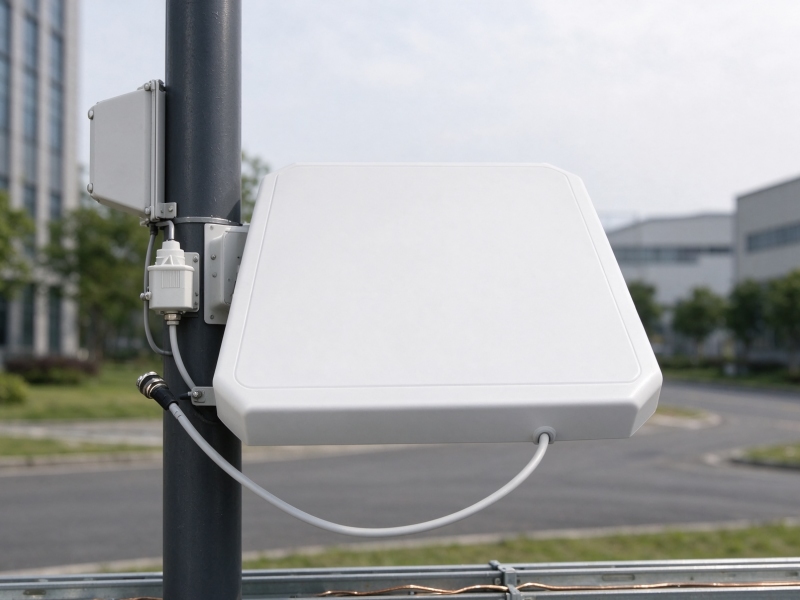
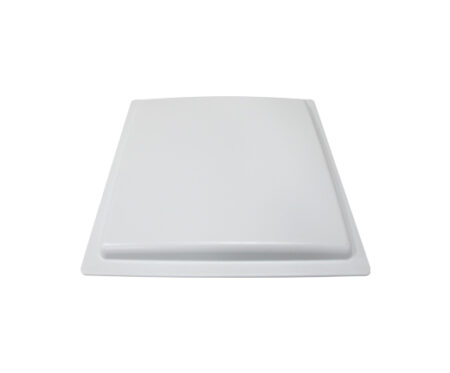
These specifications describe the 850–930MHz 8dBi RFID panel antenna. Its compact housing supports installations where mounting space is limited, while the directional radiation pattern helps concentrate RF energy toward the intended reading area. As a result, it can serve fixed RFID readers, gates, and gateway installations that require controlled coverage.
How to Choose Between Circular and Linear RFID Antennas
The choice between circular and linear polarization should reflect the actual operating conditions rather than a general preference for one technology. If tags remain in a predictable position and maintain consistent alignment, linear polarization may provide an effective solution. However, applications involving rotating packages, mixed tag orientations, or moving objects may benefit from circular polarization.
Before selecting an antenna, consider the following factors:
-
Tag Orientation: Determine whether tags remain fixed or frequently change their angle during operation.
-
Reading Zone: Evaluate whether the system needs focused coverage at a gate, workstation, shelf, or conveyor.
-
Installation Space: Check the available mounting area and the antenna’s physical dimensions.
-
RF Environment: Identify nearby metal surfaces, equipment, and other potential sources of signal reflection.
-
Reader Compatibility: Confirm that the frequency range, connector, and power requirements match the RFID reader.
Furthermore, testing the antenna in the actual installation environment can reveal coverage gaps that may not appear during a specification review. This step is particularly useful when several antennas operate within the same facility.
Applications of Compact Circular Polarized RFID Panel Antennas
Circularly polarized panel antennas are suitable for RFID applications that require directional coverage and flexible tag orientation. For example, warehouse systems can use them to identify tagged packages as products move through designated reading areas. Similarly, manufacturing facilities can integrate them into workstations to track components during different production stages.
A compact circular polarized RFID panel antenna can also support RFID gates and fixed reader installations where the antenna needs to focus coverage within a defined zone. Its compact panel structure makes it practical for wall mounting and other space-conscious arrangements. In addition, the 850–930MHz operating range and 8dBi gain of this model provide defined RF characteristics for system planning.
Renfeng develops RF antenna products for different wireless communication and identification applications. When evaluating an RFID antenna, engineers should match its frequency range, polarization, gain, and installation requirements with the reader system and tag characteristics.
Conclusion
Circular polarization offers an important advantage in RFID environments where tag orientation changes frequently. Compared with linear polarization, it reduces dependence on precise alignment and can support more flexible reading arrangements. However, antenna gain, mounting position, frequency compatibility, and surrounding RF conditions remain essential factors in achieving reliable system performance.
The 850–930MHz 8dBi panel model combines circular polarization, directional coverage, and a compact 132 × 132 × 18mm housing. By evaluating these characteristics against actual reading requirements, system designers can select an antenna configuration that better suits fixed readers, RFID gates, and other identification applications.